

You can have a great product, a good-looking website, and a decent budget, and still lose to a competitor whose pages are simply better organized for search. That difference usually lives on the page itself: the title, the headings, the content, the links, the speed, the markup.
This guide is a complete on-page SEO checklist you can run on any page of your site. It starts with how to analyze a page, walks through every element worth checking, shows a worked example, and finishes with a short section on how on-page work connects to off-page SEO.
What Is On-Page SEO?
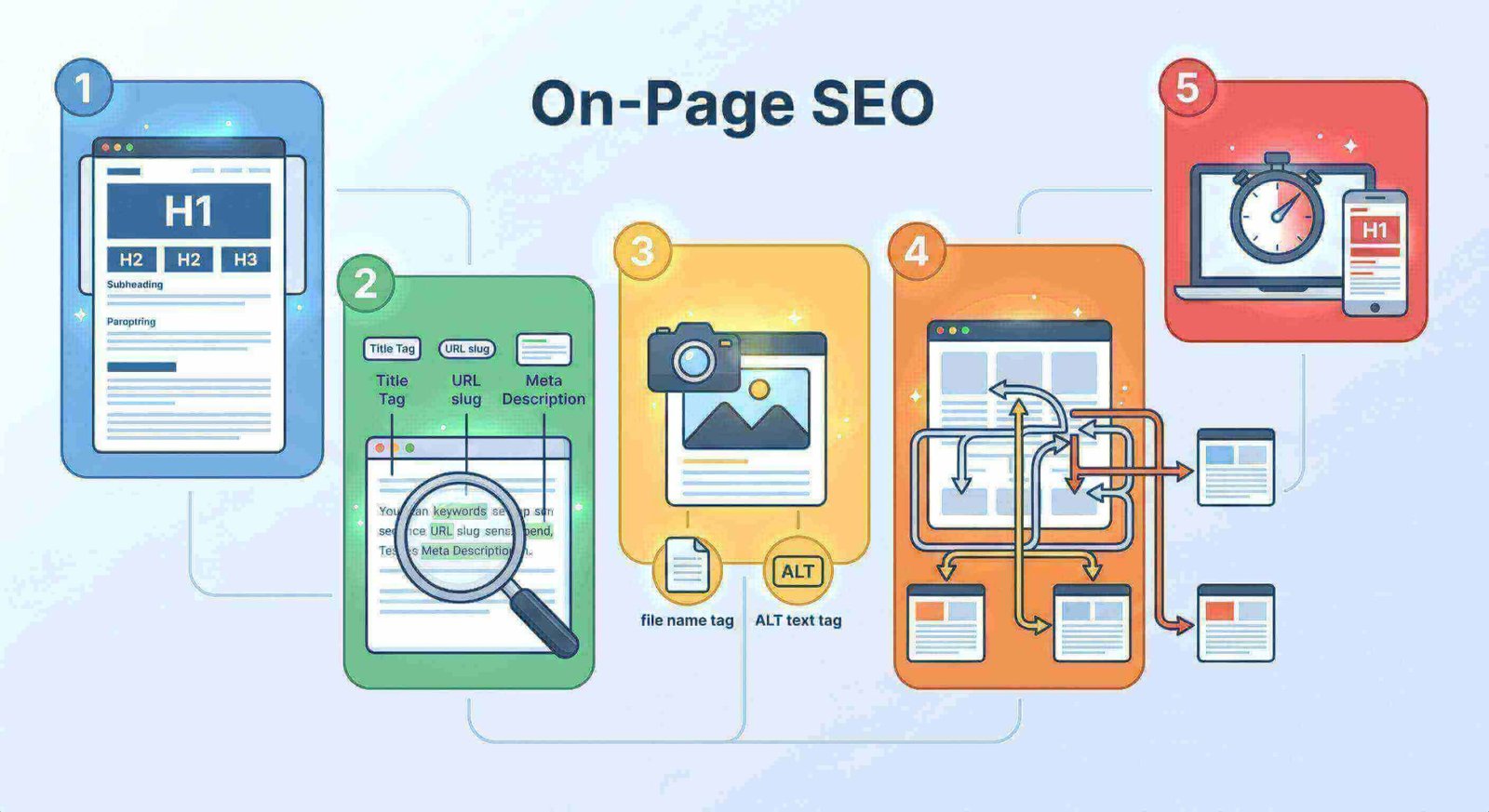
On-page SEO is everything you can change directly on a page to help it rank and convert: the visible content, the HTML elements behind it, and the technical setup that affects how search engines read it. It’s the part of SEO you fully control, which makes it the best place to start.
On-page search engine optimisation sits alongside two other areas. Technical SEO covers the site-wide foundation (crawling, indexing, speed, structure), and off-page SEO covers signals from outside your site, mainly links and reputation. In practice the lines blur. Page speed, schema, and canonical tags are technical, but they live on the page, so this checklist covers them too. If you’re newer to the terminology, our SEO glossary defines each term in plain English.
How to Run an On-Page SEO Analysis
Before changing anything, do a quick on-page SEO analysis of the page so you know what you’re fixing and why. Here’s a simple process:
- Pick one page and one primary keyword. If you haven’t chosen the keyword yet, our step-by-step keyword research guide shows how.
- Search the keyword and study page one. Note the format, depth, and angle of the pages that rank. This tells you what searchers expect.
- Open the page and check each element in this checklist. Use a free crawler or browser extension for the HTML details, and PageSpeed Insights for performance.
- Check Google Search Console. See which queries the page already appears for, its click-through rate, and its average position.
- List the gaps, then fix them in order of impact. Content and intent problems come before small tag tweaks.
Our roundup of free SEO resources and tools lists everything you need for this, at no cost. If you’re auditing many pages at once, the SEO content audit checklist shows how to sort them into keep, update, merge, or remove.
The Complete On-Page SEO Checklist
1. Search Intent and Keyword Targeting
Everything else depends on this section.
Write down:
- The page has one primary keyword and a handful of related secondary keywords
- The page type matches what searchers want (guide, comparison, service page, location page)
- The page doesn’t compete with another page on your site for the same keyword
- The content answers the main question clearly and early
Many on-page SEO keywords problems are really intent problems. If the top results are all how-to guides and your page is a sales pitch, no amount of tag editing will fix it.
2. Title Tag
The title tag is the clickable headline in search results and one of your strongest on-page signals.
- Includes the primary keyword naturally, ideally near the beginning
- Roughly 50 to 60 characters so it isn’t cut off (display is pixel-based, so treat this as a guide)
- Unique to this page
- Written to earn the click, with a benefit or clear promise, not just a keyword list
- Includes your brand name only if there’s room
3. Meta Description
- Roughly 150 to 160 characters
- Summarizes what the page offers and includes the primary keyword
- Includes a reason to click, such as a benefit, a number, or a clear next step
- Unique to this page
Meta descriptions aren’t a direct ranking factor, but they influence click-through rate. Google may replace yours with a snippet pulled from the page when it thinks that fits the query better.
4. URL
- Short, readable, and descriptive (/local-seo-checklist rather than /page?id=482)
- Includes the primary keyword where natural
- Uses hyphens between words and lowercase letters
- Avoids unnecessary parameters, dates, and stop words
Once a page is live and ranking, avoid changing its URL. If you must, set up a 301 redirect from the old one.
5. Headings (H1 to H3)
- Exactly one H1 that clearly states the topic and includes the primary keyword
- H2s divide the page into logical sections
- H3s break down subtopics beneath the H2s
- Secondary keywords and real questions appear in headings where they fit
- Headings make sense when read on their own, as an outline
Good headings help readers scan and help search engines understand structure. Don’t skip levels or use headings purely for styling.
6. Content Quality and Depth
- Answers the searcher’s question thoroughly, without padding
- Covers the subtopics that top-ranking pages cover, and adds something they don’t (original examples, data, or experience)
- The main answer appears early, not buried after long introductions
- Facts, prices, dates, and statistics are current and accurate
- Written in clear language for the intended reader, with short paragraphs
- Shows real expertise or first-hand experience where relevant
- Free of keyword stuffing, so every sentence reads naturally
Length isn’t a ranking factor on its own, but thorough pages tend to be longer. Match the depth to the topic. Our guide to writing SEO-optimized content covers this in more detail.
7. Keyword Usage
- Primary keyword appears in the title, H1, opening paragraph, and at least one subheading
- Secondary keywords and related terms appear naturally throughout
- No exact-match repetition that reads awkwardly
- Synonyms and related concepts are included, not just one phrase
The old “meta keywords” tag is ignored by Google, so don’t spend time on it. Focus on the visible content and the elements in this checklist.
8. Internal Links
- Links to 2 to 5 relevant pages on your own site, using descriptive anchor text
- At least a couple of other pages link to this one
- The page isn’t an orphan (a page with no internal links pointing to it)
- No broken internal links or long redirect chains
- Important pages are reachable within a few clicks from the homepage
Internal links help visitors move through your site and help search engines understand which pages matter. Our advanced SEO techniques article covers internal linking as a system.
9. External Links
- Links to credible sources where they genuinely help the reader
- Links open to relevant, working pages
- No links to spammy or irrelevant sites
Linking out to good sources adds credibility and context. It doesn’t hurt your rankings when done sensibly.
10. Images and Media
- Images are relevant and add real value
- File names are descriptive (roof-repair-austin.jpg, not IMG_4821.jpg)
- Alt text accurately describes each image
- Images are compressed and sized appropriately
- Modern formats such as WebP are used where possible
- Below-the-fold images are lazy-loaded
- Videos have context around them, such as a summary or transcript
Alt text exists first for accessibility, so write it for people using screen readers, not as a place for keywords.
11. Technical On-Page Elements
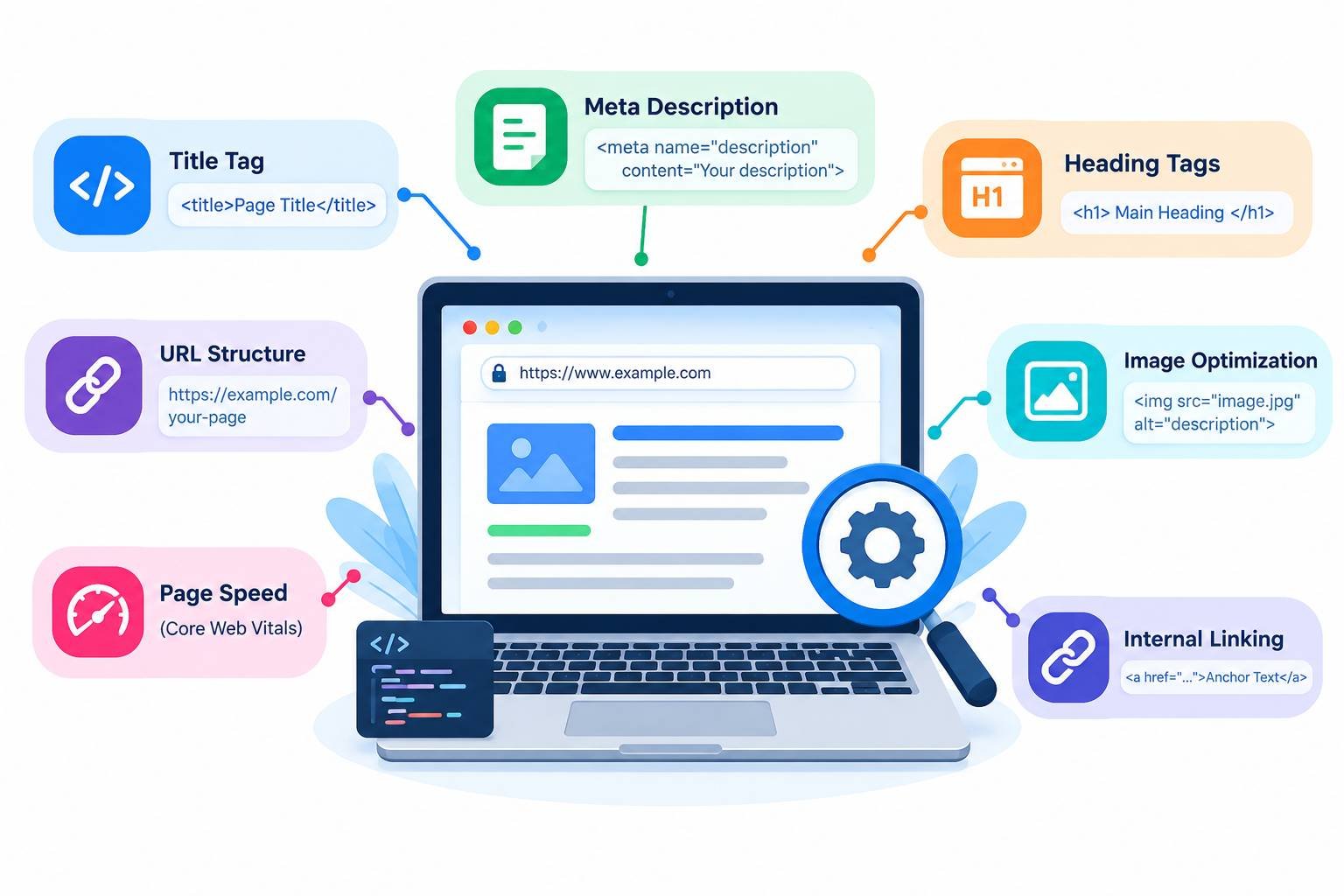
This is the “on page technical SEO” layer: technical factors that live on the page itself.
- The page is indexable (no accidental noindex tag, not blocked in robots.txt)
- A canonical tag points to the preferred version of the page
- The page returns a normal 200 status, not an error or a chain of redirects
- The site uses HTTPS
- The page is mobile-friendly and renders properly on a phone
- Core Web Vitals are acceptable, with fast loading, quick interaction, and no layout jumping
- Important content isn’t hidden behind scripts that search engines may not render
- Structured data (schema) is added where relevant and passes validation
- The page is included in your XML sitemap
Check these in Google Search Console’s URL Inspection tool, PageSpeed Insights, and the Rich Results Test. For local businesses, adding LocalBusiness schema to location and contact pages is a worthwhile step.
12. User Experience and Conversion
- The page loads quickly and looks right on mobile
- Layout is clean, with readable fonts and no intrusive pop-ups blocking content
- Contact details are easy to find, and consistent with your Google Business Profile
- Trust signals are present, such as reviews, credentials, guarantees, or case studies
Ranking only matters if the page then turns visitors into customers. Search engines also increasingly reward pages that people find genuinely useful.
13. Freshness and Maintenance
- The page has been reviewed within the last 6 to 12 months
- Outdated information has been updated, not just the date
- Broken links have been fixed
- Performance in Search Console is checked regularly
An Example of On-Page SEO in Action
Here’s a quick example of on-page SEO applied to a local service page. Imagine a roofing company targeting “roof repair Austin.”
| Element | Before | After |
|---|---|---|
| Title tag | "Services | Smith Roofing" | "Services | Smith Roofing" |
| H1 | "Our Services" | "Professional Roof Repair in Austin" |
| URL | /services-2 |
/roof-repair-austin |
| Content | 120 words of general description | Detailed sections on common repairs, pricing factors, timelines, and service areas |
| Internal links | None | Links to related pages on roof replacement, storm damage, and the contact page |
| Images | Unnamed stock photos | Compressed photos of actual jobs, with descriptive alt text |
| Schema | None | LocalBusiness markup with address, phone, and hours |
| Call to action | Phone number in footer only | Prominent "Get a free estimate" button and phone number near the top |
None of these changes is complicated, but together they turn a vague page into one that clearly answers a specific search.
On-Page vs. Off-Page SEO: How They Fit Together

On-page and off-page SEO work as a pair. On-page makes your pages worth ranking, and off-page tells search engines other people agree. If you’ve been searching on page off page seo, the simple distinction is where the work happens: on-page happens on your own pages, off-page happens elsewhere.
Off-page SEO elements include:
- Backlinks from other websites (the most important off-page signal)
- Brand mentions and citations, with or without a link
- Reviews and reputation on Google and industry platforms
- Social and community presence that spreads your content
- Digital PR and partnerships that earn coverage
Off-page SEO activities and steps typically follow this order:
- Make sure the on-page foundation is solid, since links to weak pages are wasted
- Create content worth linking to, such as original guides, data, or tools
- Claim and clean up your business listings and citations
- Reach out to relevant partners, publications, and local organizations
- Earn and respond to customer reviews
- Track new links and mentions, and watch for spammy ones
- Measure outcomes, not just rankings. Track leads, calls, and conversions from each page, so you know which keywords actually earn money.
A common mistake is putting effort into off-page SEO optimisation before fixing the page. If the content doesn’t match intent, links won’t rescue it. Fix the page first, then build authority around it. We cover the link side in detail in our guide to building quality backlinks.
Common On-Page SEO Mistakes
- Targeting several unrelated keywords on one page. Each page should have one clear focus.
- Duplicate title tags and meta descriptions across many pages.
- Thin content that doesn’t fully answer the query.
- Keyword stuffing instead of natural writing.
- Forgetting internal links, leaving good pages isolated.
- Ignoring mobile and speed. Slow, clumsy mobile pages lose both rankings and customers.
- Ignoring mobile and Missing alt text and oversized images.speed. Slow, clumsy mobile pages lose both rankings and customers.
- Changing URLs without redirects.
- Optimizing once and never revisiting. Content ages and competitors improve.
How to Prioritize When You Have Many Pages
You won’t fix every page at once, so start where the payoff is biggest:
- Pages that drive or could drive revenue, such as service, product, and location pages
- Pages ranking on page two, where a small improvement can move them onto page one
- Pages with high impressions but low click-through, which often need better titles and descriptions
- Pages with outdated or thin content
- Everything else, as time allows
Review your most important pages every quarter. Small, regular improvements add up faster than a big overhaul once a year.
Putting the Checklist to Work
Print this list or copy it into a spreadsheet, and run it page by page, starting with your most valuable pages. Mark each item as done, needs work, or not applicable, then fix the highest-impact gaps first. Within a few weeks you’ll usually see improvements in click-through rate, and rankings follow over the following months as search engines reprocess the changes.
If you’d rather have an expert review your pages and hand you a prioritized fix list, Market RiseUp offers a free SEO audit that covers on-page, technical, and local factors, with clear next steps based on your site.

Miftahul Islam is an SEO professional and digital marketing strategist with 10+ years of experience in technical SEO, content strategy, link building, and organic search growth. He is the founder of Market Riseup, where he researches emerging search trends and helps businesses build sustainable digital visibility.

Services
Get In Touch
USA Office:
909 N Madison St, Madisonville, Texas, 77864
Bangladesh Office:
Haider Plaza, Dariapur, Gaibandha, 5700
©2026 Market Riseup All Rights Reserved.